
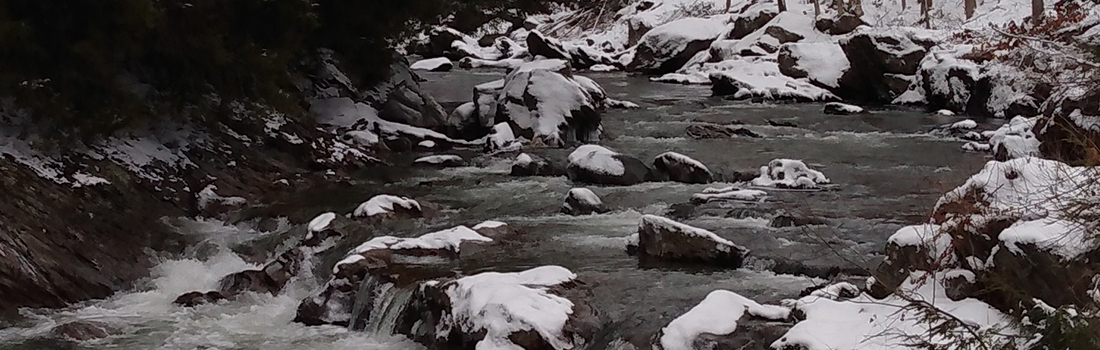
Trout River in Winter
The Trout River Terrace
After careful grooming, the edge of the Hazen’s Notch Road, in Montgomery, Vermont, provides close, continuous views of the cascading Trout River, its sprawling picturesque ledges, and its evergreen-capped rock walls
In 2025 the Evergreen Foundation completed its first major landscape project since it opened the Birchwood woodland garden, in Montgomery, Vermont, in 2023. The Foundation groomed the banks of the Trout River, at the beginning of the Hazen’s Notch Road (Route 58) in Montgomery, thereby creating the Trout River Terrace, which provides a long, close roadside view of the exciting cascading stream.
This section of the Trout River is a rare and precious landscape in at least three ways:
First, it’s one of those wonderful places where a road or a path runs close enough to a river, lake, or other water body, for a long enough time, to allow uninterrupted views of the water and, ideally, pretty scenery on the opposite shore.
One of these landscapes is the justly celebrated Route 5A along the shore of Lake Willoughby, in northern Vermont. Often just a few feet from the water, the road provides continuous views of the lake and the craggy Mount Hor springing up on the opposite shore, less than half a mile away.
Other notable highway viewpoints include:
- Route 5 in Barton, Vermont, which runs for nearly 2½ miles along Crystal Lake, offering continuing aerial views of the lake and the precipitous slopes of May Hill on the eastern shore.
- Route 111, which follows the shore of Lake Seymour, in Morgan, Vermont, for nearly half a mile, delivering a continuous vista of Vermont’s third largest lake.
- Interstate 93, which swoops close to Moore Reservoir, in Littleton, New Hampshire, serving up a mile-long view of New Hampshire’s eighth largest lake.
Closer to Montgomery, Route 118 runs for three quarters of a mile along the south shore of the unspoiled Belvidere Pond, offering unbroken views of the 93-acre pond and the mountains (including the 3,360-foot Belvidere) all around it.
Second, this part of the Trout River is especially scenic because it’s a flume: It doesn’t flow gently, like many streams, over a wide bed. Instead, it’s squeezed between its steep ledgy banks, so even at low water, lots of small white cascades fall over its rocky bed. At high water, such as spring snow melt, the river is frothy white as it surges over and around large and small rocks and sprawling ledges.
Third, the opposite bank of the river is a beautiful rock-water-and-evergreen composition. Gardenlike sweeps of hemlocks and other evergreen trees grow atop the river’s gray ledge walls, and white water splashes against the rock.
For decades, the Hazen’s Notch Road’s glorious river views were blocked by trees and brush on the town-owned site. With the Select Board’s approval, Japanese knotweed, honeysuckle, and other invasive species were eradicated, and dead trees and brush were removed. To safeguard against erosion, grass on the site was not mowed, and large trees were not cut down. Instead, to open up views, large trees were limbed up to eye level.
The Hazen’s Notch Road now offers a tenth of a mile of continuous views of the cascading river, its picturesque ledges, and the fringe of evergreens on its opposite bank.
The grooming also uncovered a dramatic outlook, projecting over the stream bank, which allows even closer views of the river.
The Foundation added a red wooden bench to the edge of the overlook—and it’s more than a place to sit and savor the view. It’s also a pretty focal point, a dash of bright color in an otherwise green landscape, and a decoration that—like a piece of sculpture—marks the site as a special place: not an ordinary roadside but a naturalistic park with extraordinary features; one at which you should pause—or at least slow down—to enjoy.
Photo by Wendy Howard
Trout River in Winter.
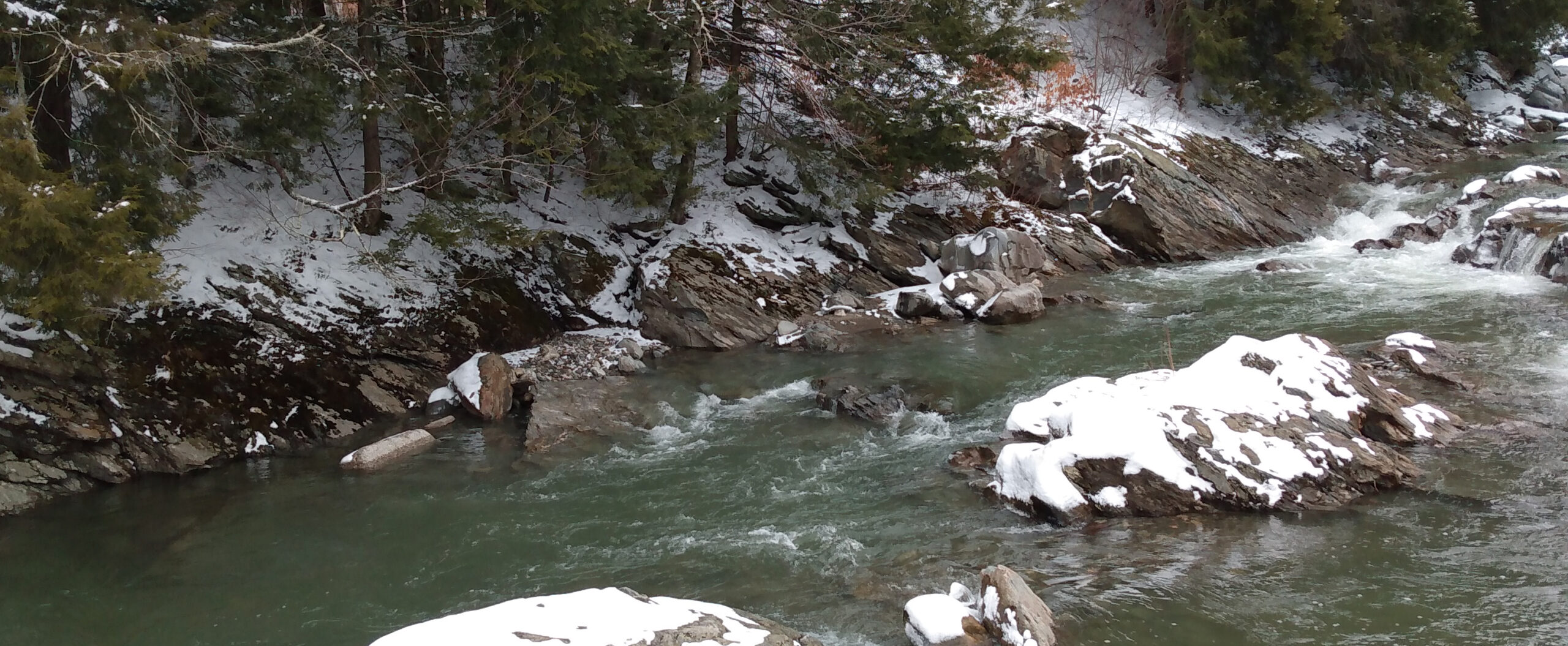
Photo by Wendy Howard